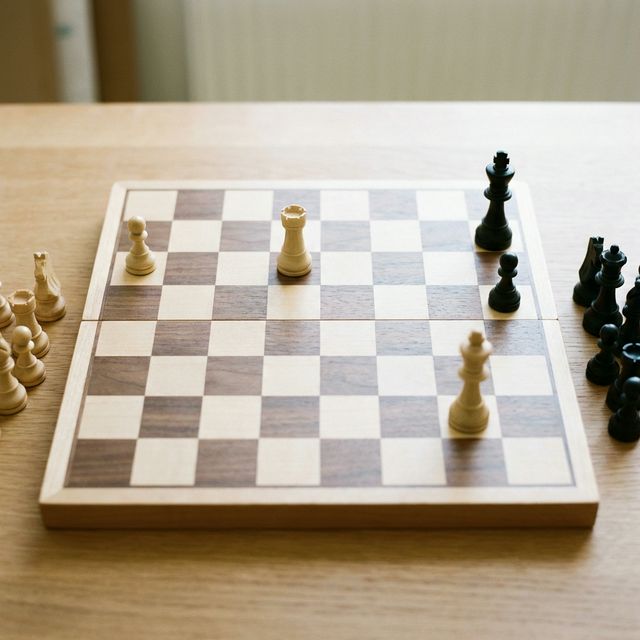
There is no feeling in chess quite as soul-crushing as brilliantly outplaying your opponent for 40 moves, achieving a completely winning position, and then inexplicably blundering it all away in the final stretch. You had the full point firmly in your grasp, and you let it slip through your fingers. Every experienced tournament player knows this agony intimately.
The tragic phenomenon of failing to convert winning positions is an epidemic at the club level. Players rated between 1200 and 1800 routinely squander decisive advantages that a Grandmaster would convert with mechanical precision. Why does this happen? And more importantly, how do you fix it forever?
In this detailed masterclass, we will dissect the psychological and technical reasons behind conversion failures, and provide you with a concrete, repeatable system for turning your advantages into full points on the scoreboard.
Part 1: Why Players Choke in Winning Positions
Understanding the psychology of conversion failure is the first step toward curing it. When you suddenly realize you are winning, a dangerous cascade of mental shifts occurs inside your brain:
The Relaxation Trap: Your subconscious tells you the hard work is done. You fought brilliantly to reach this position; surely the win will "play itself." This subtle relaxation causes you to stop calculating with the same intensity that got you the advantage in the first place. You begin making moves on autopilot.
The Fear Response: Paradoxically, being winning can trigger intense anxiety. You suddenly become terrified of throwing away your beautiful advantage. This fear manifests as overly passive, defensive play. Instead of continuing to play the objectively strongest moves, you start making "safe" moves designed merely to avoid losing. You voluntarily surrender the initiative.
The Impatience Virus: Knowing you are winning, you desperately want the game to end immediately. You start looking for quick knockout blows and forced checkmates that simply do not exist in the position. This impatience leads to speculative sacrifices, premature attacks, and ultimately, terrible blunders.
The Respect Deficit: When you are significantly ahead, you subconsciously begin to disrespect your opponent. You assume they will passively accept their fate. In reality, a desperate opponent with nothing to lose is the most dangerous opponent of all. They will set every conceivable trap, complicate the position at every turn, and fight tooth and nail for survival.
Part 2: The Golden Rule — Simplify Ruthlessly
If you remember absolutely nothing else from this entire article, remember this single principle: When you are up material, trade pieces.
The logic behind this rule is elegantly simple and mathematically irrefutable. Every piece that comes off the board reduces your opponent's tactical resources. With fewer pieces, there are fewer possible combinations, fewer tricks, fewer swindle opportunities, and fewer ways for them to generate counterplay against your king.
Consider this: if you are up a full Knight and there are Queens, Rooks, Bishops, and Knights still swarming the board, your opponent has enormous tactical potential despite being down material. But if you systematically trade off the Queens, then the Rooks, then the remaining minor pieces, you reach a King and Pawn endgame where your extra Knight has been converted into an extra pawn or a decisive positional advantage. In a pure King and Pawn endgame, even a single extra pawn is almost always a trivially winning advantage.
How to force trades effectively:
- Aggressively centralize your pieces so they contest the same squares as your opponent's pieces, creating natural trade opportunities.
- Use tactical motifs like pins and forks specifically to force exchanges rather than win more material.
- Offer your Queen for their Queen whenever the resulting endgame is clearly winning for you. Many amateurs irrationally refuse to trade Queens even when it guarantees a won endgame.
- Do not avoid trades simply because "Rooks and Queens are fun to play with." Fun is irrelevant; winning is the objective.
Part 3: Eliminate All Counterplay
The second pillar of clean conversion is the systematic elimination of your opponent's counterplay. A desperate opponent will do everything possible to muddy the waters: they will create threats against your king, push passed pawns on the opposite wing, sacrifice material to open lines, and generally try to inject chaos into the position.
Your job is to deny them every single one of these resources before they materialize.
Practical counterplay elimination:
Secure your King absolutely. Before doing anything aggressive, ensure your King is completely safe. If there is even a hint of a back-rank mate threat, fix it immediately with a simple luft (h3 or g3). A single-move investment in King safety can prevent a game-ending disaster.
Control the open files. If your opponent needs an open file for their Rook to create threats, occupy that file first. A Rook on an open file is a Rook that controls the game; denying your opponent access to open files is like cutting off their oxygen supply.
Restrict their pieces. Use your pawns and pieces to systematically box in their remaining forces. A Knight trapped on the rim, a Bishop blocked by its own pawns, a Rook stuck defending a weakness — each restricted piece brings you closer to a position where your opponent literally cannot create a single threat.
Fix their weaknesses. If your opponent has a structural weakness like an isolated pawn or a backward pawn, resist the temptation to immediately capture it. Instead, simply keep it fixed in place as a permanent target. The weakness ties down their pieces to its defense, giving you freedom to operate elsewhere on the board.
Part 4: The Technique of the Passed Pawn
In many converted endgames, the concrete winning mechanism is the creation and promotion of a passed pawn. A passed pawn is a pawn that has no enemy pawns blocking its path to the promotion square. Creating one and shepherding it to the eighth rank is the most common way to actually win a game from a material advantage.
Step-by-step passed pawn technique:
- Create the passed pawn. Trade pawns on one side of the board to create a pawn that has no opposition. Alternatively, use your extra pawn advantage to create a pawn majority on one wing and advance it.
- Centralize your King. In the endgame, the King is a fighting piece. Bring it to the center of the board where it can support the advancing pawn and simultaneously threaten enemy pawns.
- Use the passed pawn as a decoy. Even if the passed pawn itself cannot promote, it forces the opponent's pieces to babysit it. While they are occupied stopping your pawn, your King freely invades on the opposite side and captures their defenseless pawns.
- The outside passed pawn wins. A passed pawn on the flank (a-file or h-file) is devastatingly effective because it forces the opponent's King to travel to the extreme edge of the board to stop it, leaving the center and opposite wing completely undefended.
Part 5: Practical Discipline — The Mental Checklist
Before every single move in a winning position, run through this simple mental checklist:
- Is my King safe? If not, fix it before doing anything else.
- Can my opponent create any immediate threats? If yes, neutralize them prophylactically.
- Is there a forced piece trade available? If yes, take it unless it concretely worsens your position.
- Am I being patient? If you feel the urge to "finish things quickly," that is almost always a warning sign. Slow down.
- What would a computer do here? The strongest engines in the world convert advantages by making simple, boring, safe moves that gradually improve their position. Emulate that approach.
Conclusion: Be the Executioner
Converting winning positions is not glamorous. It does not produce the flashy sacrificial combinations that make it onto YouTube highlight reels. It is quiet, methodical, and often feels tedious. But it is the single most impactful skill you can develop for your tournament results.
The greatest players in history — Capablanca, Karpov, Carlsen — were all legendary converters. They did not need to play brilliantly to win; they simply needed to be better at not making mistakes when they were ahead. Their opponents would gradually run out of ideas, run out of squares for their pieces, and eventually resign in quiet desperation.
Train yourself to be the executioner. Trade pieces, eliminate counterplay, create passed pawns, and above all, be patient. The full point will come.
Next in our series, we explore the analytical discipline that underpins all improvement: how to Analyze Your Games Like an Elite Coach. Because even the best execution means nothing if you are not learning from every single game you play.