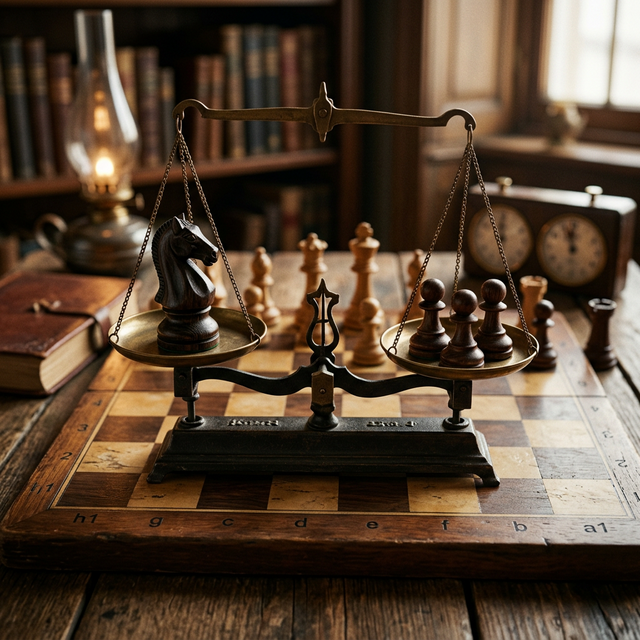
Chess is almost never, under any circumstance, a game of perfect, aesthetic symmetry. While it is physically true that both entirely equal, perfectly mirrored armies violently clash at move one, by the time move ten arrives on the board, the entire landscape is typically, radically transformed forever. A powerful, leaping knight might be violently traded for a long-range bishop, defensive pawns on the flank might be hopelessly doubled and crippled, or one aggressive side might have permanently conquered a massive, suffocating chunk of central space while the other hides behind barricades.
These glaring, fundamental, undeniable differences between the two armies are precisely called Imbalances.
The renowned, legendary International Master and esteemed chess author Jeremy Silman heavily popularized and codified the profound concept of strict "imbalance thinking" in his timeless masterpiece How to Reassess Your Chess. He violently argued that pathetic amateur players desperately look for generic, random "good moves" or cheap tricks, while true masters coldly look at the specific, mathematical inequalities currently existing on the board and let those exact inequalities rigidly dictate and forge their entire, overarching grand strategy. Mastering an understanding of imbalances is absolutely the final, heaviest key to unlocking a profound, master-level positional understanding of the game of kings.
Part 1: What Fundamentally is an Imbalance?
At its core, an imbalance is any tangible, identifiable, structural, or piece-based difference between the White and Black positions. Everything on the 64 squares of the chessboard that is not perfectly, symmetrically mirrored is technically an imbalance.
Your absolute, primary job as an improving chess player is to accurately identify exactly which imbalances currently highly favor you, and systematically play in a way that maximizes their devastating impact, while simultaneously, desperately minimizing the specific imbalances that unfortunately favor your opponent.
Here are the absolute most critical, game-deciding imbalances that you must learn to aggressively exploit if you wish to dictate masterful play.
1. Superior Minor Pieces (The Bishop vs. Knight Debate)
When evaluating material in a complete vacuum, beginners are taught that Knights and Bishops are both uniformly worth precisely 3 points. In the harsh reality of an active chess game, however, their true, dynamic value wildly and violently fluctuates based entirely on the specific, underlying pawn structure of the exact position.
The Crushing Bishop's Advantage: Fast, sweeping Bishops heavily thrive in wildly open positions where the pawns have been aggressively traded off and remain on both vastly separated sides of the board. They are terrifying long-range snipers. If you possess the famous "Bishop Pair" (both of your bishops) while your opponent tragically only has a slow Knight and a Bishop, your grand strategy is remarkably simple: blow up the center of the board. Aggressively trade off multiple central pawns, rip open the files and massive diagonals, and mercilessly let your Bishops rake completely across the board, overwhelming the slow, hopping Knights.
The Suffocating Knight's Advantage: Powerful Knights are, conversely, short-range, brutal brawlers that intensely excel in "closed" or "locked" positions where static pawns are tightly locked together, heavily blocking and entirely neutralizing all long diagonals. A Knight passionately loves occupying an "outpost": a beautiful, secure square located deep inside dark enemy territory (typically the 5th or 6th rank for White) that is heavily protected by a friendly pawn, which an enemy pawn mathematically cannot ever attack. If you have "good Knights" aggressively marching against pathetically useless "bad Bishops," you must desperately keep the position entirely locked down and slowly, excruciatingly squeeze your opponent to death.
e5 outpost, immediately establishing a massive, undeniably permanent imbalance over White's restricted pieces.
2. The Suffocating Space Advantage
If your majestic pawns have bravely marched considerably further down the central ranks of the board than your opponent's retreating pawns (for example, if you control proud White pawns firmly embedded on d5 and e5), you proudly possess a massive, undeniably powerful Space Advantage.
A severe space advantage logically means that your pieces miraculously possess far more room to comfortably maneuver around and reposition themselves behind your towering pawn lines, while your opponent's pathetic pieces are cramped, miserable, and physically stepping on each other's toes trying to find a safe square.
How to ruthlessly, systematically exploit a Space Advantage:
- Absolutely Do Not Trade Pieces. This is the golden rule. When the opponent is severely cramped and lacks oxygen, every single piece trade you allow them to make "frees up" massive room for their remaining, suffocating pieces. Desperately keep the tension high and the pieces crowded!
- Rapidly Shift the Attack: Shift your heavy attacking pieces rapidly, violently from one side of the board to the exact opposite side. Because you command significantly more space, you can effortlessly reorganize and swing your pieces laterally orders of magnitude faster than your cramped, paralyzed opponent can theoretically reorganize their defenders. They will arrive late to the defense, and they will perish.
3. Exploitable Pawn Structure Defects
We covered foundational pawn structures quite heavily in our previous, exhaustive masterclass, but you must realize that specific, glaring structural defects create massive, eternally exploitable imbalances that grandmasters hunt like wolves.
- Crippling Doubled Pawns: When two pawns of the exact same color are unfortunately, awkwardly stuck on the exact same vertical file (usually resulting from a capture). They are heavily often weak, slow, unable to defend each other, and fundamentally clumsy. However, a nuanced master knows that possessing terribly doubled pawns sometimes, miraculously grants you immediate, aggressive access to the wide semi-open file situated right next to them to mount a heavy Rook attack!
- Tragic Backward Pawns: A pitiful pawn that has tragically fallen irrevocably behind all of its friendly neighbors and physically cannot ever be defended by another pawn again. It is a permanent target. The square situated immediately in front of a backward pawn is a notoriously weak hole, representing a prime, magnificent outpost for an invading enemy Knight to dominate!
If your opponent unfortunately happens to suffer from a heavily crippled, shattered pawn structure early in the game, your grand strategy is simple: ruthlessly trade off all the active, attacking minor and major pieces to aggressively transition the game into a simplified endgame. In the endgame, those static, unchangeable structural weaknesses become mathematically fatal, and you will simply round them up and win.
4. Holding the Initiative and Lead in Development
The revered Initiative is a highly ephemeral, incredibly temporary, hyper-dynamic imbalance. It simply and fundamentally means: You are currently the specific player on the board aggressively making immediate, terrifying threats, and your opponent is entirely relegated to the pathetic role of reacting to them.
Possessing a massive lead in rapid development or fiercely holding the dynamic initiative is a temporary advantage. It definitively does not last forever. If your opponent manages to survive, they will catch up. Therefore, if you currently hold the initiative, you absolutely must play energetically, violently, and without hesitation. You must aggressively create terrifying new threats on every single turn, bravely sacrifice material if it is strictly necessary to keep their king exposed and the momentum going, and absolutely do not ever let the opponent catch their breath or structurally consolidate their fragile position.
Conversely, if you are currently the unfortunate soul desperately defending against a terrifying initiative, your goal is survival through simplification. Desperately attempt to trade off their most dangerous active pieces! Significantly reducing the size of their attacking army makes sheer defense completely and exponentially easier mathematically.
Part 2: The Masterful Formula for Strategic Dominance
Putting all of this profound theory together, here is the exact, unshakeable protocol you must rigidly follow during your serious tournament or online games:
- Stop and Coldly Survey: The absolute moment the 15-move opening phase firmly ends, you must violently pause. Disengage from random calculations.
- Ruthlessly List the Imbalances: Mentally point out exactly, specifically what is structurally different on the board. State it as a fact: "I definitively have the powerful Bishop pair, but he undeniably has a far safer King. I boast a massive queenside pawn majority, but he terrifyingly possesses overwhelming central control."
- Logically Formulate a Specific Plan: Create a grand, overarching plan that aggressively amplifies your distinct advantages. "Since I unequivocally have the powerful Bishop pair and an incredibly safer king, I will aggressively and proudly sacrifice a pawn on the
d5square to violently rip open the center, fully unleashing my Bishops' terrifying power while simultaneously, fatally exposing his severely weakened King." - Execute and Continually Adjust: Pursue your calculated plan ruthlessly, with extreme prejudice, but always remain incredibly flexible and highly ready to abruptly adapt when the opponent's counterplay logically forces the fundamental pawn structure to drastically change yet again.
Conclusion: Stop Playing Chess, Start Playing Imbalances
Amateurs react emotionally to individual, isolated moves. They see a threat, they wildly panic, and they randomly defend.
True masters react coldly and logically to underlying imbalances. By actively and mathematically identifying the incredibly unique, complex "texture" of the position—the highly superior minor pieces, the crippling pawn defects, and the suffocating space advantage—you permanently stop randomly guessing. The 64 squares of the board itself, through its imbalances, actually begin to loudly and clearly tell you exactly what you must do to achieve victory.
Now that you have gloriously, masterfully learned how to deeply read the board and navigate the incredibly complex middlegame strategically, it is absolutely time to learn exactly how to mathematically deliver the ultimate, crushing killing blow.
Join us in the next intense chapter of our masterclass as we dive completely horizontally into the absolute most thrilling, adrenaline-pumping aspect of chess imaginable: Brutally Attacking the Castled King.
Prepare the heavy cavalry, load the artillery, and ready your sacrifices!