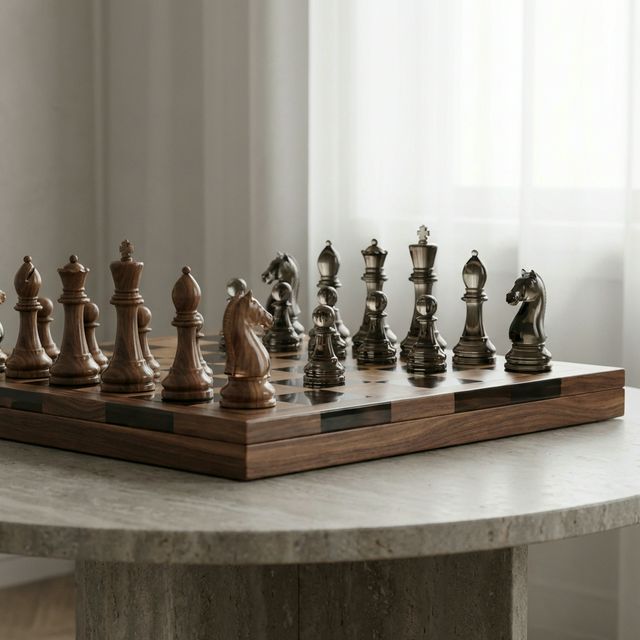
In the dynamic hierarchy of minor pieces, a single Bishop is generally considered roughly equal to a single Knight — both valued at approximately 3 points. However, when two Bishops are united on the board, especially in an open or semi-open position, they transcend their individual values. The "Bishop Pair" routinely acts as a monstrous strategic force, often evaluated by modern engines as worth an additional half-pawn (or more) compared to a Bishop-and-Knight or two-Knight combination.
But why exactly is the Bishop Pair so powerful? And more importantly, how can you leverage this advantage in your own games? This guide explores the strategic principles behind the Bishop Pair, explains how to create the conditions where it thrives, and details how to convert the advantage into winning positions.
Why the Bishop Pair Is So Powerful
Complete Color Coverage
A single Bishop, by definition, is blind to exactly half the squares on the chessboard. A light-squared Bishop can never attack or defend a dark square. This is a fundamental limitation that opponents can exploit by placing pawns and pieces on the "safe" color.
When both Bishops are alive and coordinating, this limitation vanishes. Together, they control every color complex on the board, creating a comprehensive net of influence that restricts the opponent's piece mobility. There is literally no safe color for the opponent's pieces to hide on.
Range and Speed
Bishops are long-range pieces. A Bishop on b2 can simultaneously control the a1-h8 diagonal — influencing squares from a1 all the way to g7 in a single "glance." In contrast, a Knight on b2 needs four or five moves to reach g7. This speed advantage compounds when both Bishops are active: they can reposition across the entire board in one or two moves, while Knights laboriously hop from square to square.
Coordinated Pressure
Two Bishops firing on adjacent diagonals create a devastating crossfire effect. Imagine a light-squared Bishop on b1 controlling the b1-h7 diagonal and a dark-squared Bishop on b2 controlling the a1-h8 diagonal. Together, they dominate a massive portion of the board. The opponent must defend against threats on both color complexes simultaneously, which is significantly harder than defending against threats on only one.
Flexibility
Unlike Knights, which need specific outpost squares to be effective, Bishops adapt to the position. When the game transitions from middlegame to endgame, when pawns are traded and the board opens up, Bishops naturally improve without requiring additional maneuvering. The Bishop Pair becomes progressively stronger as the game simplifies — which means the advantage of possessing it grows over time rather than diminishing.
The Optimal Environment: Open Positions
The Bishop Pair thrives in open positions — positions where central pawns have been traded away, leaving massive, unobstructed diagonals spanning the board.
In a closed position with locked pawn chains, Knights often outshine Bishops because they cleverly hop over the barricades. However, in an open center, the Knights are hopelessly outranged. A Bishop positioned on b2 might simultaneously defend the queenside, exert pressure on the center, and target the kingside in a single glance. A Knight requires four moves to traverse that same territory.
Half-Open Positions
Even in semi-open positions — where one or two central pawns have been exchanged — the Bishop Pair holds significant sway. As long as the Bishops have reasonable diagonal scope, they outperform the opposing minor piece combination. The key threshold is whether the Bishops have at least one good diagonal each. If both Bishops are restricted to short diagonals, the advantage diminishes.
Strategic Plan: Opening the Board
If you possess the Bishop Pair and your opponent has a Bishop and Knight (or two Knights), your paramount strategic goal is clear: you must open the position.
Techniques for Opening the Board
Central pawn breaks. Push your central pawns forward to force pawn exchanges. Every pawn trade opens a file and typically clears at least one diagonal. Moves like d4-d5, e4-e5, or c4-c5 (depending on the structure) are typical tools.
Pawn sacrifices. Sometimes you should willingly sacrifice a pawn to force the center open. If the resulting open position gives your Bishops dominant diagonals, the pawn is a worthwhile investment. A common example: playing d5 even when the opponent can capture and win the pawn, because the resulting open diagonals for your Bishops are worth more than the material.
Trading pieces, not pawns. While you want to open the pawn structure, you generally want to reduce the number of pieces on the board (except your Bishops). Fewer pieces mean fewer obstacles blocking your Bishops' diagonals and fewer defenders for your opponent.
Avoiding pawn chain locks. Do not allow the opponent to lock the pawn structure. If they try to play moves like e5 and d4, creating a rigid pawn chain, consider trading pawns immediately to prevent the lockdown.
Restricting the Enemy Knights
While your Bishops dominate distances, they also possess a secondary superpower: paralyzing enemy Knights from afar.
How Bishops Restrict Knights
Because Bishops control many squares from a long distance, you can position them to cover the exact squares where enemy Knights want to jump. A Knight needs outpost squares — stable, centralized squares where it can sit comfortably. If your Bishops are scanning those outpost squares like sentries, the Knight can never safely occupy them.
Practical example: If the opponent's Knight wants to reach d5 (a powerful central outpost), place your dark-squared Bishop on e3 or c3 — both diagonal squares that attack d5. Now the Knight cannot safely land on d5 without being captured. The Bishop performs this duty effortlessly from a distance, while the Knight would need to be right next to d5 to dispute it.
The Knight Restriction Strategy
A comprehensive anti-Knight strategy involves:
- Identify the Knight's ideal squares — where does it want to go? d5, e5, c5, f4, c4, etc.
- Position your Bishops to cover these squares from a safe distance.
- Keep the center open so the Knight has nowhere to hide behind pawn chains.
- Force the Knight to the rim through your Bishop pressure. "A Knight on the rim is grim" — Knights on edge squares control only 2-4 squares instead of 8.
When done correctly, this strategy renders the opponent's Knights essentially useless — passive pieces that occupy space but contribute nothing to the game.
The Bishop Pair in the Endgame
The advantage of the Bishop Pair magnifies dramatically as pieces are traded and the game transitions to an endgame. In a pure minor piece endgame (Bishops vs. Bishop + Knight, or Bishops vs. two Knights), the Bishop Pair is often a decisive advantage.
Why Endgames Favor the Bishop Pair
Fewer pieces mean more open lines. With Rooks and Queens exchanged, the board naturally opens up. Pawns become the only obstacles, and there are fewer pieces blocking diagonals.
Multi-flank operations. In endgames, the action often occurs on both flanks simultaneously. Bishops excel at multi-flank operations — a Bishop on d3 can influence both the Kingside (h7) and the Queenside (a6) in the same position. Knights, limited by their slow movement, often cannot get from one flank to the other in time.
Pawn hunting. The Bishop Pair is notorious for efficiently scooping up enemy pawns on both flanks simultaneously. Their long-range mobility allows them to defend a passed pawn on the a-file while also stopping an enemy passed pawn on the h-file — something Knights simply cannot do.
King support. In endgames, the King becomes an active fighting piece. The Bishop Pair supports the King's advance beautifully, covering squares around the King from a safe distance while the King marches forward.
Converting the Bishop Pair Advantage in Endgames
Follow these principles to convert your Bishop Pair into a win:
- Activate your King. Centralize your King aggressively. The Bishop Pair provides excellent cover for the King's march.
- Create passed pawns. Use the Bishops' long-range power to support pawn advances and create passed pawns.
- Target weaknesses. With Bishops on both colors, you can attack weaknesses on either color complex. Alternate your threats between the light-squared and dark-squared weaknesses to stretch the opponent's defense thin.
- Avoid unnecessary piece trades. You want to keep your Bishops! Do not trade one Bishop unless the resulting position is clearly winning regardless.
When the Bishop Pair Is NOT Advantageous
Despite its general strength, there are situations where the Bishop Pair is not particularly valuable:
Closed Positions
In tightly locked pawn structures with no prospect of opening the center, Knights can outperform Bishops. If your Bishops are stuck behind your own pawns with minimal scope, the Bishop Pair advantage evaporates.
When One Bishop Is "Bad"
If one of your Bishops is restricted by your own pawn structure (a "bad" Bishop), the effective advantage of the Bishop Pair decreases significantly. You effectively have one active Bishop and one passenger.
Tactical Positions Favoring Knights
In positions with many tactical possibilities — forks, outposts, closed centers with tactical skirmishes — Knights can be more dangerous than Bishops. If the position demands constant maneuvering around fixed pawn structures, Knight flexibility trumps Bishop range.
Material Imbalances
If the opponent has significant compensation for lacking the Bishop Pair (such as a stronger pawn center, better piece activity, or an initiative), the Bishop Pair alone may not be sufficient.
Acquiring the Bishop Pair
Understanding the value of the Bishop Pair also means knowing when and how to acquire it:
Recognize when your opponent trades a Bishop for a Knight. Every Bxf6 or Bxf3 trade gives the other side the Bishop Pair. Before trading your Bishop for a Knight, ask: "Am I giving my opponent a long-term Bishop Pair advantage?"
Provoke the trade. If you can force your opponent to trade one of their Bishops for your Knight (e.g., by placing your Knight on an annoying square that the Bishop must capture), you acquire the Bishop Pair as a strategic bonus.
Preserve your Bishops. When your opponent tries to trade one of your Bishops (Bg5 vs. your Nf6, leading to Bxf6), consider whether accepting the trade gives up the Bishop Pair. Sometimes retreating the piece or repositioning to avoid the trade is worth the tempo investment.
Famous Bishop Pair Games
To truly internalize the power of the Bishop Pair, study these games:
- Fischer vs. Petrosian, Candidates 1971 — Fischer demonstrates the crushing power of the Bishop Pair in an open position, systematically restricting Petrosian's Knights.
- Kasparov vs. Karpov, World Championship 1990, Game 4 — Kasparov leverages the Bishop Pair into a dominant endgame position with relentless precision.
- Carlsen vs. Anand, World Championship 2013 — Several games showcase Carlsen's ability to create open positions where his Bishop Pair dominates.
Conclusion
Securing the Bishop Pair is a long-term strategic investment. It requires foresight, patience, and a deep understanding of pawn structures. The formula is straightforward: acquire the Bishop Pair, open the position, restrict the enemy Knights, and convert the advantage in the endgame. If you can maintain both Bishops into a wide-open middlegame or endgame, you will often find that the advantage plays itself — your Bishops will dominate the board, control both color complexes, and gradually crush the opponent's inferior minor pieces. Master this concept, and you add one of chess's most powerful strategic weapons to your arsenal.