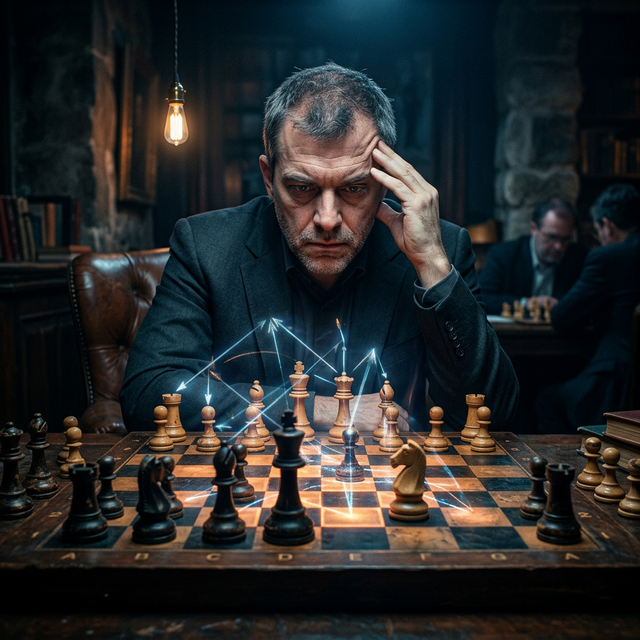
In the vast, beautifully complex world of competitive chess, there exists a profound, almost mystical concept that seemingly separates the merely "good" club-level players from the truly elite, untouchable grandmasters. It is a concept that requires intense discipline, incredible foresight, and a complete suppression of one's own ego. This concept is called Prophylaxis.
Coined and heavily popularized early in the 20th century by the brilliant, deeply eccentric grandmaster and father of hypermodern chess, Aron Nimzowitsch, prophylaxis fundamentally refers to the highly strategic, conscious act of proactively anticipating, understanding, and actively preventing your opponent’s tactical threats and strategic positional ideas before they can ever physically execute them on the board.
Amateurs famously play "solitaire chess." They stare obsessively at their own pieces, formulate a wild, attacking plan, and attempt to bulldoze their way through the position, completely, tragically ignoring what the person sitting across from them is desperately trying to accomplish. Grandmasters, on the other hand, play a completely different game. A grandmaster sits down, surveys the board, and asks themselves one incredibly chilling, paranoid question on absolutely every single move: "If it were my opponent's turn to move right now, what exactly would they do to destroy me?"
In this exhaustive, highly advanced masterclass, we will meticulously dissect the profound theory behind prophylaxis, train your brain to fundamentally start seeing the board through your opponent's hostile eyes, and learn exactly how to utilize preventative thinking to slowly, agonizingly suffocate your opponents into utter submission.
Part 1: The Core Philosophy - Respecting the Enemy
The absolutely fundamental, non-negotiable prerequisite for playing prophylactic chess is developing a profound, unwavering respect for your opponent's intellect. You must permanently discard the highly arrogant, deeply flawed amateur assumption that your opponent is simply going to sit there passively, twiddle their thumbs, and kindly allow you to execute your beautiful, elegant 10-move checkmating sequence without raising a fuss.
Chess is a vicious two-player game. Your opponent is heavily armed, they have a deeply calculated plan of their own, and they actively want to crush you.
Prophylaxis begins the very moment you completely stop asking, "What do I want to do?" and violently shift your entire focus to asking, "What does my opponent desperately want to do?"
Once you accurately and consistently identify their deepest desires—perhaps they desperately want to plant a heavily annoying Knight firmly on the d5 outpost, or wildly push their f-pawn to launch a terrifying kingside attack, or violently trade off your incredibly powerful light-squared Bishop—you then dedicate all of your vast resources to ensuring that their specific dream absolutely never, mathematically becomes a reality.
When you successfully, repeatedly prevent their best ideas, they are violently forced to settle for their second, third, or fourth-best, inferior plans. They become deeply frustrated. They overextend. They blunder.
Part 2: Tactical Prophylaxis vs. Strategic Prophylaxis
Prophylaxis beautifully manifests itself in two entirely distinct, equally devastating forms on the 64 squares: tactical and strategic.
Tactical Prophylaxis: The Art of Preventative Medicine
Tactical prophylaxis is the incredibly concrete, brutally necessary process of actively foreseeing an immediate, highly forcing tactical threat (such as a devastating fork, a paralyzing pin, a deadly discovered attack, or a sudden, game-ending checkmate) and stepping out of its invisible radius before the trap is ever physically sprung.
The classic example: You aggressively move your powerful Queen to the highly active c2 square to aggressively eye the opponent's castled King. However, you violently realize that your Queen now casually sits on the exact same open, long diagonal as the opponent's incredibly dangerous dark-squared Bishop, currently harmlessly blocked by a single pawn.
An amateur ignores this entirely, happily continues attacking, and tragically loses their Queen five moves later to a sudden, discovered attack when the pawn moves.
A master utilizing tactical prophylaxis immediately, calmly maneuvers their Queen off of that dangerous, cursed diagonal to absolute safety before the opponent even realizes the tactical possibility existed. They cure the disease before the agonizing symptoms ever appear.
a3, seemingly a useless, terrible pawn move that wastes a turn, solely to indefinitely completely prevent the annoying Black Knight from ever aggressively jumping to the b4 square to attack the incredibly valuable Bishop on d3. Prevention is far better than a cure.
Strategic Prophylaxis: The Long-Term Squeeze
Strategic prophylaxis is vastly deeper, significantly more profound, and infinitely more suffocating to experience. It involves deeply anticipating your opponent's long-term positional plans and methodically, slowly adjusting your pawn structure and heavy piece placement to completely structurally deny them any active counterplay whatsoever.
It is the chess equivalent of slowly wrapping a massive python around their position and gently squeezing until they can no longer breathe or move a single piece forward. By permanently controlling the absolute key squares they desperately need for their pawn breaks, you render their entire, painfully constructed position strategically completely inert and useless.
Part 3: The Three Grand Prophylactic Questions
To practically and forcefully implement this terrifying mindset into your actual, real-life tournament games, you must vigorously train yourself to automatically, instinctively ask yourself three highly critical questions before you ever touch a piece on the board:
- "What is my opponent's absolute most dangerous, violently annoying active piece, and exactly where does it desperately want to eventually go?"
If their powerful Knight profoundly wants to aggressively jump into the gaping hole on
e5, you must immediately heavily reinforce your own complete control over that specific central square using your pawns and bishops so the Knight can never physically land there without being violently captured. - "What specific pawn break is my opponent agonizingly trying to desperately prepare?"
Every solid chess position fundamentally relies heavily on executing pawn breaks to finally open lines for the dormant Rooks. If you can deeply foresee that Black is meticulously preparing the massive, liberating
...c5pawn break to challenge your central dominance, you must maneuver your own heavy pieces to heavily over-protect thec5square, ensuring that if they ever tragically push the pawn, they will simply violently lose material. - "If I aggressively play my brilliant intended move, what terrifying new weakness does it permanently, physically create in my own camp?" Every single time you move a piece forward to violently attack, it permanently leaves behind a highly vulnerable square that it used to securely guard. When you violently push a pawn forward, the squares directly beside it become permanently hollowed out and incredibly weak. You must actively foresee these newly created, permanent weaknesses and mathematically ensure your brilliant attack is actually fully justified before you carelessly create them.
Part 4: The Incredible Danger of "Ghost" Prophylaxis
While mastering prophylaxis is absolutely essential, non-negotiable for reaching the coveted master level, there is a very real, incredibly dangerous psychological pitfall that often actively ruins deeply aspiring players: "Seeing Ghosts."
Seeing ghosts nervously occurs when a highly paranoid player completely stops furiously playing for their own active, winning plans and instead timidly spends 100% of their valuable time and energy desperately preparing defensive, passive moves against wildly imaginary, non-existent, or incredibly weak attacks their opponent hasn't even slightly begun to meaningfully orchestrate.
If your opponent is passively shuffling their pieces on the remote back rank, utterly devoid of a central plan, do not waste five incredibly valuable turns defensively playing prophylactic pawn moves on the flank! If they lack any actual, credible threat, you must completely ignore their shuffling, violently seize the immediate initiative, dictate the tempo of the game, and aggressively attack them! Prophylaxis is merely a tool used to suppress real, active counterplay, absolutely not an excuse to play cowardly, hyper-passive chess out of sheer, irrational fear.
Conclusion: The Mind of the Master
Prophylactically playing chess is undeniably incredibly exhausting. It requires vast reserves of deep, intense focus, massive, prolonged calculation, and a profound, fundamental shift in your entire psychological approach to the game.
It asks you to temporarily, violently forget entirely about your own brilliant desires and intensely look through the hostile, calculating eyes of your opponent. But when you finally master this incredibly dark art, your physical results will dramatically, incredibly skyrocket.
You will begin to hear your deeply frustrated opponents sigh loudly across the board. They will violently complain that "they simply couldn't find a single decent move" and that their entire position felt hopelessly "suffocated and cramped." That is the incredible, beautiful target you must aggressively aim for.
As we move directly toward the incredibly decisive, final stages of the game in our comprehensive series, prophylaxis becomes infinitely, vastly more important. In our next incredibly detailed masterclass, we will dive profoundly into the incredibly technical, highly mathematical, and notoriously unforgiving realm of the endgame: Rook Endgames That Absolutely Win and Draw. The opening is theory, the middlegame is planning, but the endgame is pure, unadulterated calculation!