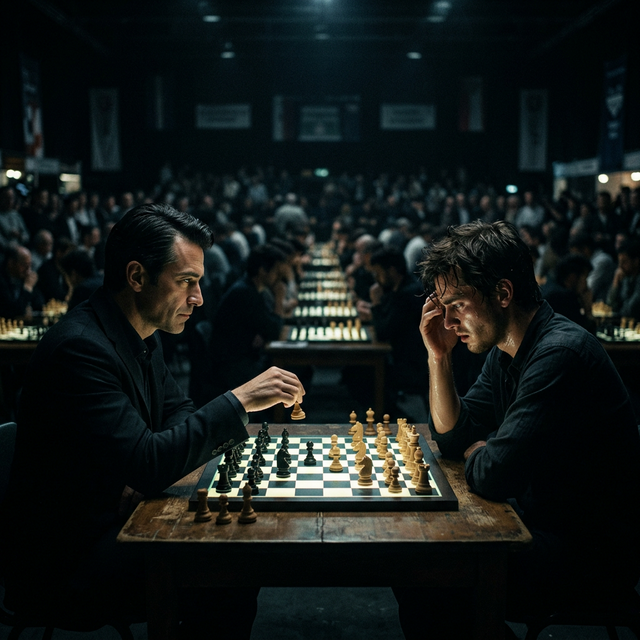
Chess is often described as a pure battle of logic and intellect. But anyone who has played a serious tournament game knows the truth: chess is equally a battle of nerves, emotions, and raw psychological resilience. The player who calculates the best moves does not always win. The player who maintains composure under pressure, manages their emotions, and makes the fewest impulsive decisions is the one who walks away with the trophy.
At the elite Grandmaster level, the theoretical knowledge gap between opponents is negligible. Both players know the same openings, understand the same strategic principles, and can calculate to similar depths. The decisive factor in these encounters is almost always psychological. Who handles the pressure better? Who stays calm after a blunder? Who refuses to give up in a lost position?
For club players, the psychological dimension is even more important. Your games are filled with mutual errors, and the player who recovers faster from mistakes, thinks more clearly under time pressure, and avoids emotional decision-making will consistently outperform opponents with superior theoretical knowledge but weaker mental discipline.
Part 1: Understanding Tilt — The Silent Rating Killer
"Tilt" is a term borrowed from poker that describes the state of emotional frustration that leads to increasingly poor decision-making. In chess, tilt manifests in several devastating ways:
Post-blunder tilt: You make a terrible mistake and immediately lose confidence. Instead of objectively assessing the new position and finding the best practical chances, you mentally give up. You start playing quickly and carelessly, compounding one mistake with another until the game is hopelessly lost.
Post-loss tilt: You lose a painful game and immediately sit down for the next round still emotionally devastated. You are not thinking about the new game; you are replaying the previous loss in your head. Your concentration is shattered, and you play well below your actual strength.
Opponent-induced tilt: Your opponent plays quickly and confidently, and you interpret their speed as a sign that they have prepared deeply for this exact position. You begin to doubt your own moves, second-guessing perfectly sound decisions. Their confidence becomes your anxiety.
How to combat tilt:
- Recognize it immediately. The moment you feel frustration, anger, or self-pity affecting your thoughts, name it: "I am tilting." This simple act of recognition creates psychological distance between you and the emotion.
- Take a physical break. Stand up from the board, walk away, drink water, and take several deep breaths. Even 60 seconds of physical movement can reset your mental state.
- Refocus on the position, not the game. Stop thinking about the blunder you made five moves ago. The position on the board right now is the only thing that matters. Treat it as if you just sat down at this position with no history.
- Between rounds, develop a reset ritual. Listen to calming music, take a walk outside, or do a brief breathing exercise. Never sit down for a new game while still emotionally processing the previous one.
Part 2: Clock Management as Psychological Warfare
Time management is one of the most neglected aspects of competitive chess, yet it has an enormous impact on both your play quality and your opponent's psychological state.
The dangers of time trouble: When you are low on time, your calculation becomes shallow and error-prone. You start relying on intuition and pattern recognition rather than rigorous analysis. You miss tactical nuances, overlook defensive resources, and make impulsive moves you would never play with a full clock. Studies have shown that the error rate in chess positions roughly doubles when a player has less than 5 minutes remaining compared to having 30+ minutes.
Strategic time allocation:
- Spend your time on critical positions, not routine ones. Recapturing a piece or making an obvious developing move should take 10-30 seconds, not 5 minutes.
- Invest heavily in positions where the evaluation could swing significantly based on your decision. These are the moments that decide the game, and they deserve your deepest thought.
- If you find yourself spending more than 10 minutes on a single move, you are almost certainly overthinking. Make your best assessment and move on.
- Always ensure you have at least 5-10 minutes remaining when you enter the endgame. Endgame technique requires precise calculation, and time pressure in the endgame leads to catastrophic errors.
Using your opponent's time pressure against them: When your opponent is running low on time, play solidly and avoid unnecessary complications. Do not create positions where a single intuitive move from them solves all their problems. Instead, create positions that require precise, multi-move calculation — exactly the kind of thinking that becomes impossible under time pressure.
Part 3: The Art of Playing Against Stronger Opponents
One of the most psychologically challenging situations in tournament chess is facing an opponent rated significantly higher than you. Many club players defeat themselves before the game even begins, approaching the board with a defeatist attitude that becomes a self-fulfilling prophecy.
Common psychological traps against stronger opponents:
- Playing overly passively because you "just want a draw." Ironically, passive play against a stronger opponent almost guarantees a loss. Strong players excel at exploiting passive positions with slow, grinding technique.
- Avoiding theoretical lines because you assume the stronger player "knows everything." In reality, even titled players have gaps in their opening knowledge, and playing your prepared lines with confidence often leads to positions where rating differences matter less.
- Playing overly aggressively in a desperate attempt to "surprise" the stronger player with wild tactics. While creative play is valuable, reckless aggression against a strong tactician is suicidal.
The correct approach:
- Play your normal game. The moves that are objectively strongest do not change based on your opponent's rating.
- Stay in the fight psychologically. Stronger players are not infallible; they blunder too, especially in time pressure. Give them opportunities to make mistakes by keeping the position complex and dynamic.
- Focus on the board, not the person. When you catch yourself thinking "My opponent is a National Master," redirect your attention to the specific position in front of you. The pieces do not know what rating the players hold.
Part 4: Handling the Psychology of a Winning Position
As we covered in our previous chapter on converting winning positions, the psychological challenges of being ahead are real and dangerous. But there is an additional psychological dimension worth exploring: the fear of success.
Many players subconsciously sabotage their own winning chances because they are more comfortable with the role of the underdog than the role of the front-runner. Winning creates expectations — if you beat a strong opponent today, people will expect you to perform at that level consistently. This pressure can cause unconscious self-sabotage.
Antidotes to the fear of success:
- Process-oriented thinking: focus on making the best move in the current position, not on the result. The result is a consequence of good decisions, not something you control directly.
- Normalizing winning: the more frequently you practice converting advantages (even in training games), the more natural the winning process becomes the feeling subsides.
- Post-game affirmation: after a well-converted game, take a moment to acknowledge the quality of your play. Build a positive association with the act of winning cleanly.
Part 5: Pre-Game Mental Preparation
Your psychological state when you sit down at the board is largely determined by what you did in the hours before the game. Elite athletes in every sport take pre-competition mental preparation seriously, and chess players should do the same.
A practical pre-game routine:
- Review your opening preparation briefly (15-20 minutes). Focus on the key ideas and typical plans, not on memorizing long theoretical lines.
- Solve 5-10 tactical puzzles to sharpen your pattern recognition and activate your calculating brain.
- Eat a balanced meal 1-2 hours before the game. Avoid heavy meals that cause drowsiness and sugary snacks that lead to energy crashes.
- Arrive at the venue early. Rushing to the board stressed and flustered is a terrible way to start a game.
- Set a simple intention for the game: "I will calculate carefully on every move" or "I will manage my clock well today." Having a single mental focus point keeps you grounded.
Conclusion: The Inner Game
Chess improvement is not purely about learning more openings, solving more puzzles, or studying more endgames. At a certain point, your practical results are limited not by your chess knowledge but by your psychological management. The player who stays calm under pressure, recovers quickly from mistakes, manages their clock wisely, and plays with consistent confidence will always outperform an equally skilled player who is emotionally volatile.
Invest in your mental game as seriously as you invest in your tactical training. Keep a psychological journal alongside your analysis notebook. Track your emotional patterns, identify your triggers, and develop specific coping strategies for each one.
The board is just a board. The pieces are just pieces. The real battle is inside your head.
Next up in our comprehensive series, we explore a closely related topic: The Deep Psychology of Chess — the cognitive science behind how Grandmasters think, how memory works in chess, and how to train your brain for peak performance.